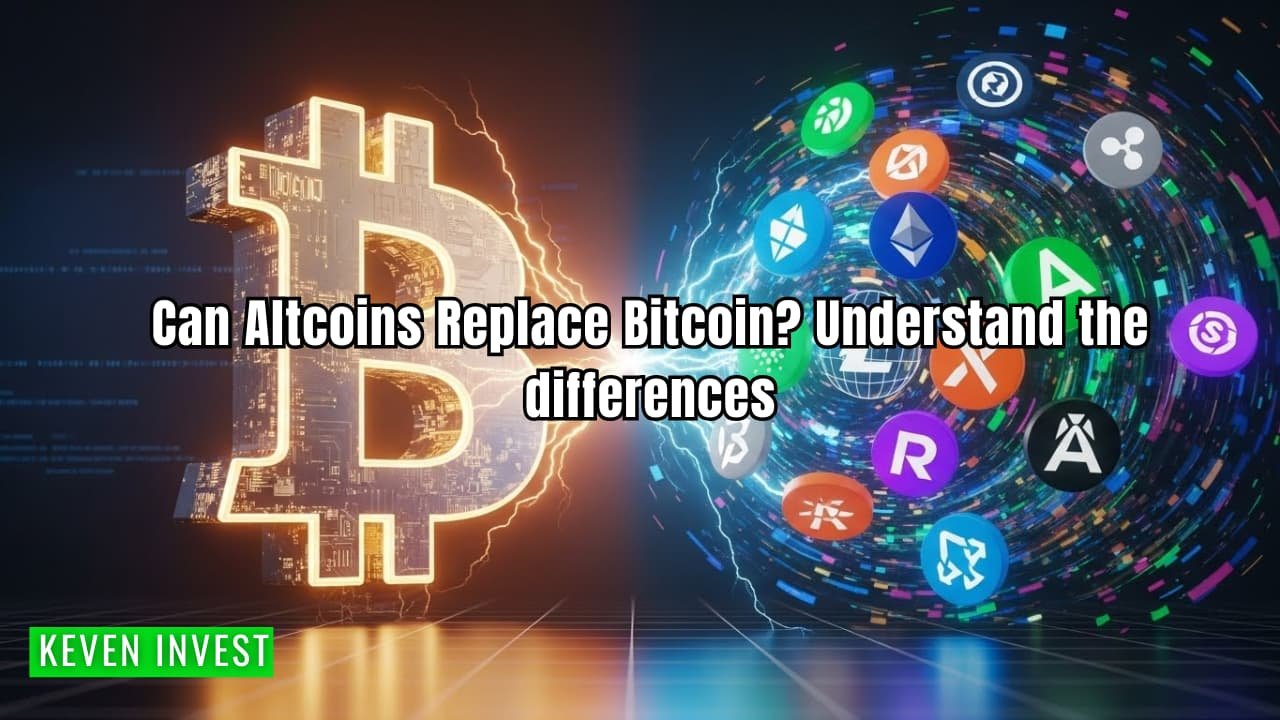
The cryptocurrency market has evolved rapidly over the past few years, especially within the American market and economic landscape, where innovation, institutional capital, and technology move together. In this context, one question is being asked more and more often: can altcoins replace Bitcoin?
This question is not only technical, but also economic, strategic, and emotional, because Bitcoin represents far more than a digital asset. It symbolizes financial freedom, decentralization, and a break from the traditional financial system.
At the same time, altcoins continue to gain traction, solve specific problems, and offer solutions that Bitcoin was never designed to provide. So, which one truly dominates the future?
Throughout this complete, educational, and in-depth article, you will understand the differences between Bitcoin and altcoins, how they position themselves in the American market, their use cases, risks, advantages, and most importantly, whether altcoins can actually replace Bitcoin.
What Is Bitcoin and Why Is It So Important?
Bitcoin was launched in 2009 by Satoshi Nakamoto with a clear objective: to create a decentralized financial system, free from intermediaries, resistant to censorship, and independent of governments and central banks.
In the U.S. economic environment, Bitcoin quickly gained recognition as a digital store of value, often compared to gold.
Bitcoin’s Original Purpose
Bitcoin was not created to do everything. It was created to be simple, secure, and immutable. Its main focus is:
-
Peer-to-peer value transfer
-
Programmed scarcity (21 million coins)
-
Maximum security
-
Extreme decentralization
These pillars make Bitcoin a unique asset, especially during periods of inflation, economic uncertainty, and declining trust in fiat currencies—topics that are extremely relevant to the American market.
Bitcoin as a Store of Value in the United States
In the United States, large institutional funds, publicly traded companies, and even Bitcoin ETFs now view the asset as a hedge against inflation.
This has strengthened the narrative that Bitcoin is not just a cryptocurrency, but a global macroeconomic asset.
What Are Altcoins and Why Did They Emerge?
Altcoins are all cryptocurrencies that are not Bitcoin. They emerged because, while Bitcoin is revolutionary, it has technical limitations.
And it is precisely within this gap that altcoins find their purpose.
The Purpose of Altcoins
Altcoins were created to solve specific problems, such as:
-
Scalability
-
Transaction speed
-
Smart contracts
-
Decentralized applications (dApps)
-
DeFi, NFTs, and Web3
While Bitcoin focuses on security and decentralization, altcoins focus on innovation and functionality.
Popular Altcoins in the American Market
In the U.S. cryptocurrency market, several altcoins stand out:
-
Ethereum (ETH) – The foundation of the DeFi and smart contract ecosystem
-
Solana (SOL) – High speed and low transaction costs
-
Cardano (ADA) – Academic, research-driven, and sustainability-focused
-
Avalanche (AVAX) – Built for scalability and institutional use
These altcoins do not directly compete with Bitcoin in every aspect, but instead occupy specific niches.
Fundamental Differences Between Bitcoin and Altcoins
Understanding whether altcoins can replace Bitcoin requires a clear analysis of the structural differences between them.
Decentralization
Bitcoin remains the most decentralized asset in the entire crypto market.
Many altcoins, however, involve some level of centralization, whether in governance, validation, or development.
👉 This is a critical factor, especially for American investors who prioritize security, transparency, and regulatory clarity.
Network Security
Bitcoin has the largest hashrate in the world, making network attacks virtually impossible.
Altcoins, on the other hand, can be more vulnerable, especially smaller projects.
Supply and Monetary Policy
-
Bitcoin: fixed and predictable supply
-
Altcoins: many have inflation, token burns, or flexible monetary rules
This difference directly impacts each asset’s role as a store of value.
Can Altcoins Replace Bitcoin Technologically?
From a technological perspective, many altcoins are indeed more advanced.
They offer smart contracts, staking, on-chain governance, and real-world integrations.
However, technology alone does not replace trust.
Bitcoin Is Simple by Design
Bitcoin does not evolve quickly because it doesn’t need to.
Its simplicity is a strategic advantage, especially in a market like the United States, where regulation, security, and predictability matter deeply.
Altcoins Innovate, but Carry More Risk
Altcoins evolve faster, but that also means:
-
Bugs
-
Security vulnerabilities
-
Frequent protocol changes
Therefore, despite being more modern, they have not yet reached the robustness level of Bitcoin.
The Role of Altcoins in the American Market
In the U.S. economic landscape, altcoins are generally seen as growth assets, while Bitcoin is viewed as a capital preservation asset.
Institutional Investors and Altcoins
American investment funds allocate to altcoins primarily for:
-
Portfolio diversification
-
Exposure to innovation
-
Short- and mid-term returns
However, when the focus is capital protection, Bitcoin remains dominant.
Regulation in the United States
The SEC and other U.S. regulators scrutinize altcoins more closely.
Many are considered securities, while Bitcoin is widely recognized as a digital commodity.
👉 This regulatory distinction makes it more difficult for altcoins to replace Bitcoin in the American market.
Can Altcoins Replace Bitcoin as a Store of Value?
This is the core of the debate.
A Store of Value Requires Trust
To function as a store of value, an asset must be:
-
Scarce
-
Decentralized
-
Secure
-
Widely accepted
Bitcoin meets all of these criteria.
Most altcoins do not.
Altcoin Volatility
Altcoins are significantly more volatile.
This makes them unreliable as a store of value, especially in a mature market like the United States.
How to choose an altcoin: basic criteria for beginners – LEARN NOW
So, Can Altcoins Replace Bitcoin?
The short answer is: not entirely.
But the correct answer is more nuanced.
Bitcoin and Altcoins Are Not Enemies
They are complementary.
-
Bitcoin: store of value, market foundation, security
-
Altcoins: innovation, utility, growth
In the American market, this complementary relationship becomes more evident every year.
The Future Is a Hybrid Ecosystem
It is far more likely that the future will consist of:
-
Bitcoin as the foundation
-
Altcoins as the infrastructure layer
This model is already taking shape in the U.S. through ETFs, regulation, and institutional adoption.
How to choose an altcoin: basic criteria for beginners – LEARN NOW
A Smart Strategy for Investors
For those investing in the cryptocurrency market, especially in the United States, the smartest approach is not choosing one side, but understanding the role of each asset.
Bitcoin for Protection
Bitcoin functions as a digital safe haven, particularly during times of economic uncertainty.
Altcoins for Growth
Altcoins offer higher upside potential, but with greater risk.
👉 A balanced portfolio recognizes this distinction.
Conclusion: Bitcoin Remains Irreplaceable, but It Is Not Alone
Altcoins will not replace Bitcoin, but they are also not going away.
They serve different purposes within a decentralized financial ecosystem that is still in its early stages.
In the American market, Bitcoin remains the central pillar, while altcoins expand what is possible.
Understanding this dynamic is essential for anyone who wants to invest with clarity, strategy, and long-term vision.
In the end, the real question is not whether altcoins can replace Bitcoin, but rather:
👉 Do you truly understand the role each one plays in the future of money?
How to choose an altcoin: basic criteria for beginners – LEARN NOW