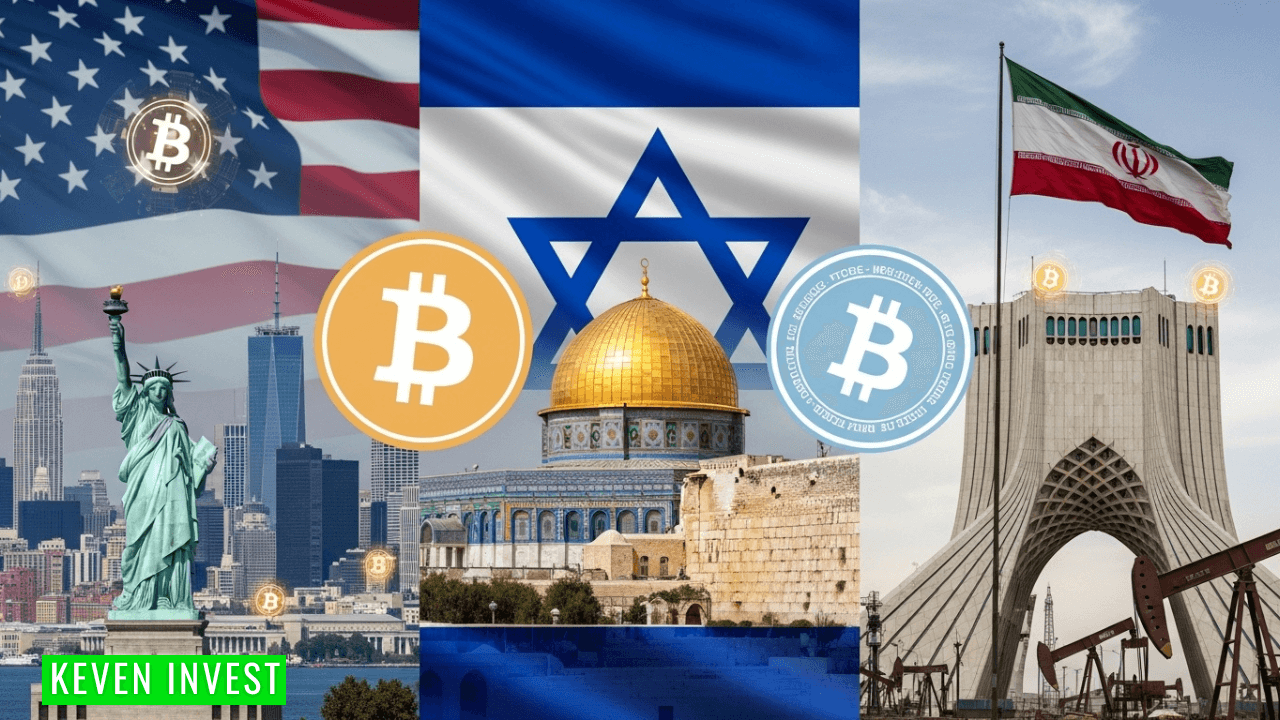
Can a War in the Middle East Bring Bitcoin Down or Push It Higher?
The question dominating the American financial market right now is direct: does Bitcoin fall or rise during a war in the Middle East?
When we talk about a war in the Middle East, we are referring to one of the most strategic regions on the planet. Critical energy routes, major oil producers, and long-standing geopolitical tensions are all concentrated there. So, any significant conflict can trigger global shockwaves.
And Bitcoin, as a global digital asset that is highly sensitive to risk, liquidity, and monetary policy, does not remain unaffected.
American investors want to know: does Bitcoin fall or rise during a war in the Middle East? The answer is not simple, because it depends on multiple factors. However, in this strategic and in-depth article, you will clearly understand how the market reacts, which macroeconomic forces come into play, and which scenarios are most likely.
Get ready for a professional, clear, educational analysis fully focused on the United States market.
War in the Middle East: Why Is the Impact Global?
A war in the Middle East is not merely a regional event. It directly impacts:
-
Oil prices
-
Inflation in the United States
-
Federal Reserve monetary policy
-
The U.S. dollar
-
Global risk appetite
And then the central question arises again: does Bitcoin fall or rise during a war in the Middle East?
To answer that, we must understand the chain reaction.

The Market’s First Reaction: Fear and Volatility
The immediate impact on Bitcoin
Historically, when a conflict begins, the market reacts with fear. Investors seek liquidity and safety. Therefore, assets considered risky come under pressure.
Bitcoin, despite its narrative as a digital store of value, still shows high volatility. Because of that, in the short term, it is common for Bitcoin to fall during a war in the Middle East.
Why?
Because investors sell positions to:
-
Increase cash holdings
-
Buy U.S. dollars
-
Move into Treasury bonds
So yes, in the initial phase, Bitcoin may fall.
But that is only the beginning of the story.
The Role of Oil: The Real Driver of Impact
A war in the Middle East usually impacts oil immediately.
If there is disruption in routes or reduced production:
-
Oil prices rise
-
Energy costs increase
-
Inflation accelerates
And when inflation rises in the United States, the Federal Reserve must respond.
Therefore, the question “does Bitcoin fall or rise during a war in the Middle East?” inevitably passes through American monetary policy.
Federal Reserve: The Decisive Factor
If the Fed keeps rates high
If inflation increases because of oil prices, the Federal Reserve may keep interest rates elevated for longer.
And high interest rates mean:
-
A stronger dollar
-
Less liquidity
-
Pressure on risk assets
In that scenario, Bitcoin may fall.
If the Fed stimulates the economy
On the other hand, if the war slows the American economy and creates recession risks, the Fed may cut interest rates.
And lower rates mean:
-
More liquidity
-
Incentives for alternative assets
-
A possible rise in Bitcoin
So again, whether Bitcoin falls or rises during a war in the Middle East depends on the Fed’s response.
Bitcoin: Risk Asset or Protection Against Instability?
This is the major divide in the American market.
Bitcoin as a risk asset
If the market sees Bitcoin as speculative:
-
It falls alongside stocks
-
Correlation with the Nasdaq increases
-
Fear dominates
Bitcoin as a store of value
But if the narrative shifts toward protection against monetary instability:
-
Capital inflows may occur
-
Investors may seek decentralization
-
The price may rise
Therefore, collective perception shapes the outcome.

The U.S. Dollar and Its Impact on Bitcoin
In times of war, the dollar typically strengthens because it is seen as a safe haven.
A strong dollar tends to pressure Bitcoin.
However, there is an important detail: if the war generates higher public deficits and increased money printing, the dollar may weaken in the medium term.
And a weaker dollar may boost Bitcoin.
So the central question remains: does Bitcoin fall or rise during a war in the Middle East? It depends on the behavior of the dollar.
Bitcoin ETFs and Institutional Flows
Today’s market is different from previous decades.
There are now Bitcoin ETFs traded in the United States. This means large institutions have exposure to the asset.
If managers decide to reduce risk:
-
There may be significant capital outflows
-
The price may drop quickly
But if Bitcoin is viewed as a geopolitical hedge:
-
Institutional inflows may increase
-
The price may rise strongly
This institutional factor makes movements more intense.
Possible Scenarios: Complete Strategic Analysis
Scenario 1: Short Conflict
If the war in the Middle East is brief and controlled:
-
Initial volatility
-
Temporary decline
-
Gradual recovery
In this case, the impact tends to be limited.
Scenario 2: Prolonged Conflict
If the war lasts for months:
-
Elevated oil prices
-
Persistent inflation
-
High interest rates
Here, Bitcoin may face medium-term pressure.
Scenario 3: Global Systemic Crisis
If the conflict generates a global financial crisis:
-
Loss of confidence in the banking system
-
Currency instability
-
Search for alternative assets
Bitcoin may assume a stronger role as a digital store of value.
Investor Psychology: The Invisible Element
Markets are driven by emotions.
During a war in the Middle East, the dominant emotions are:
-
Fear
-
Uncertainty
-
Search for safety
In the short term, fear dominates and Bitcoin may fall. But in the medium term, the search for protection may favor scarce assets like Bitcoin.
So understanding human behavior is essential to predicting whether Bitcoin falls or rises during a war in the Middle East.
Short, Medium, and Long Term: What to Expect?
Short Term
High volatility and possible initial decline.
Medium Term
Dependence on inflation, interest rates, and monetary policy.
Long Term
Possible structural strengthening if prolonged instability undermines trust in the traditional system.

What American Investors Should Monitor
If you want to understand whether Bitcoin falls or rises during a war in the Middle East, monitor:
-
Oil prices
-
The Dollar Index (DXY)
-
Federal Reserve decisions
-
Bitcoin ETF flows
-
Inflation data
These factors will be decisive.
Conclusion: So, Does Bitcoin Fall or Rise During a War in the Middle East?
The most honest answer is: it depends.
In the short term, Bitcoin may fall due to fear and the search for liquidity.
In the medium term, everything will depend on inflation and American monetary policy.
In the long term, if there is prolonged instability and monetary expansion, Bitcoin may rise and strengthen as a decentralized alternative.
Therefore, the question “does Bitcoin fall or rise during a war in the Middle East?” does not have a single answer. But one thing is certain: the impact will be significant.
And those who understand macroeconomics, geopolitics, and market psychology will have a competitive advantage.
Because in the American financial market, strategic information is not a luxury — it is survival.