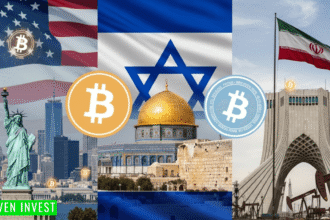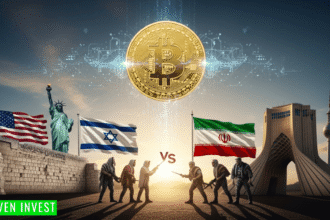
Why can a war between the United States, Israel, and Iran impact the price of Bitcoin?
A war between the United States, Israel, and Iran is a topic that immediately generates global tension. Whenever conflicts involve major powers or strategic regions of the Middle East, financial markets react. But the question millions of investors ask is: can this war interfere with the price of Bitcoin?
The answer is: yes, it can — and significantly.
The price of Bitcoin is highly sensitive to macroeconomic, geopolitical, and psychological factors. And when we talk about a potential conflict involving the United States, Israel, and Iran, we are talking about three actors with direct influence over the global economy, the energy market, and international financial stability.
In this complete, structured, and in-depth article, you will understand:
-
How wars influence financial markets
-
Why Bitcoin reacts strongly to geopolitical conflicts
-
The role of the U.S. dollar in this scenario
-
How oil enters the equation
-
The historical behavior of Bitcoin during wartime
-
What could happen in the American market
If you invest or plan to invest, this content is essential.
Understanding the Geopolitical Scenario: United States, Israel, and Iran
The strategic importance of the region
The Middle East is one of the most important regions in the world when it comes to energy, oil, and trade routes. Iran controls part of the Strait of Hormuz, through which about 20% of the world’s oil supply passes. Therefore, any military escalation in the region can directly affect oil prices.
And when oil rises, inflation in the United States can increase. And when inflation rises, the Federal Reserve may change its monetary policy. Then, automatically, the price of Bitcoin enters the equation.
The role of the United States
The United States is the world’s largest economy and the issuer of the global reserve currency: the dollar. A war involving the United States can:
-
Increase military spending
-
Pressure the public deficit
-
Raise inflation
-
Generate instability in financial markets
And all of this directly affects the cryptocurrency market.
Bitcoin as a Risk Asset or a Store of Value?
Bitcoin faces a constant dilemma in the American market: is it a risk asset like technology stocks, or is it a store of value like gold?
This question is central to understanding how a war between the United States, Israel, and Iran can interfere with the price of Bitcoin.
When Bitcoin behaves like a risk asset
In moments of panic, investors tend to sell volatile assets. And historically, Bitcoin shows high volatility. Therefore, in an initial war scenario:
-
There may be a sharp drop
-
Liquidity may dry up
-
The market may seek safety in the dollar
This has happened in previous crises.
When Bitcoin acts as protection
On the other hand, if the war generates:
-
Dollar devaluation
-
Monetary expansion
-
Distrust in the banking system
Then Bitcoin may rise, because it is seen as a decentralized and scarce asset.
And it is precisely this duality that makes the scenario complex.
The Impact of Oil on the Price of Bitcoin
A war between the United States, Israel, and Iran can drive oil prices higher. And this triggers a domino effect.
Step 1: Oil rises
If Iran blocks strategic routes, the barrel price can surge.
Step 2: Inflation increases
More expensive energy means more expensive transportation. And this impacts the entire American economy.
Step 3: The Federal Reserve reacts
The Fed may raise interest rates to contain inflation.
Step 4: Bitcoin faces pressure
High interest rates strengthen the dollar and reduce appetite for risk assets, such as Bitcoin.
So yes, a war between the United States, Israel, and Iran can interfere with the price of Bitcoin through the oil and inflation chain reaction.
History: How Has Bitcoin Reacted to Previous Conflicts?
To understand the future, we must look at the past.
Russia-Ukraine conflict
When the war began in 2022, there was an initial drop in Bitcoin. But later, at certain moments, the asset recovered.
This shows that the market reacts in two phases:
-
Initial shock and sell-off
-
Strategic repricing
U.S.-Iran tensions in 2020
When military tensions escalated in the Middle East, Bitcoin temporarily rose, being seen as protection against instability.
Therefore, the behavior is not linear. It depends on the macroeconomic context.
The Role of the U.S. Dollar
The dollar is considered a global safe haven. In times of war:
-
Investors buy dollars
-
U.S. Treasury bonds rise
-
Gold may increase
But what about Bitcoin?
If the dollar strengthens significantly, the price of Bitcoin in dollars may fall. However, if the war generates fiscal expansion and money printing, the scenario changes completely.
So everything depends on the economic response of the United States.
American Market: What Should Investors Watch?
1. Federal Reserve decisions
If the Fed signals interest rate cuts to stimulate the economy during war, Bitcoin may benefit.
2. Dollar Index (DXY)
A rising DXY generally pressures Bitcoin.
3. Oil prices
A sharp increase indicates inflation risk.
4. Stock market performance
If the Nasdaq drops sharply, Bitcoin may initially follow.
Possible Scenarios for the Price of Bitcoin
Scenario 1: Short and controlled war
Moderate impact, temporary volatility.
Scenario 2: Prolonged conflict
Persistent inflation, possible monetary intervention, high volatility in Bitcoin.
Scenario 3: Global systemic crisis
Banking distrust, flight to alternative assets, possible structural rise in Bitcoin.
Investor Psychology in Times of War
In moments of global tension, the market is driven by:
-
Fear
-
Uncertainty
-
Search for protection
Bitcoin is an asset strongly driven by narrative. And the narrative can change quickly.
If it is seen as protection against war, it rises.
If it is seen as a speculative risk asset, it falls.
And that is exactly why a war between the United States, Israel, and Iran can interfere with the price of Bitcoin in different ways at different times.
The Role of Bitcoin ETFs in the American Market
The approval of Bitcoin ETFs in the United States has changed the game.
Now large institutions have exposure to the asset. Therefore:
-
Institutional flows increase impact
-
Macroeconomic decisions influence inflows and outflows
-
Funds may reduce risk in a war scenario
This means that the price of Bitcoin may react more closely to the traditional financial market.
Bitcoin, Gold, and Safe Haven Assets
Historically, gold rises in times of war.
But Bitcoin is trying to occupy that space.
The big question is: is it already considered a true safe haven asset?
Not entirely yet. But the narrative is evolving.
What Could Happen in the Short, Medium, and Long Term
Short Term
High volatility, sharp movements.
Medium Term
Dependence on Federal Reserve decisions and inflation dynamics.
Long Term
If war reinforces the fragility of the traditional financial system, Bitcoin may benefit structurally.
Conclusion: Can a War Between the United States, Israel, and Iran Interfere with the Price of Bitcoin?
Yes, it can — and in a significant way.
A war between the United States, Israel, and Iran can interfere with the price of Bitcoin through:
-
Rising oil prices
-
Inflation in the United States
-
Federal Reserve decisions
-
Strengthening or weakening of the dollar
-
Changes in global risk perception
The American market is highly sensitive to geopolitical shocks. And since Bitcoin is increasingly integrated into the traditional financial system, it reacts quickly and intensely.
Therefore, investors need to monitor:
-
Geopolitics
-
Monetary policy
-
Energy markets
-
Institutional flows
Bitcoin does not exist in isolation. It is connected to the real world. And when there is war involving global powers, the impact can be profound.
If you invest in the American market, understanding how a war between the United States, Israel, and Iran can interfere with the price of Bitcoin is not just interesting — it is strategic.
Because in the end, information is power. And those who understand macroeconomic movements have a competitive advantage in the market.
And now you know exactly how this scenario may unfold.